
 My CV
My CV RedNote
 CSDN
CSDNUpdate: February 18th, 2026
Academic Research
Research Focus
- AIGC for fashion intelligence
- Diffusion-based controllable generation
- Garment understanding and pattern generation
iRetexturing: Intelligent Fashion Items Retexturing via Diffusion Models
- Venue: Textile Research Journal, 2025
- Authors: Yarui Zhang, Yao Jin, Xin Huang
- DOI: 10.1177/00405175251356681
- Webpage: Textile Research Journal - SAGE
- National Invention Patent Certificate: View Certificate
- Software Copyright Certificate: View Certificate
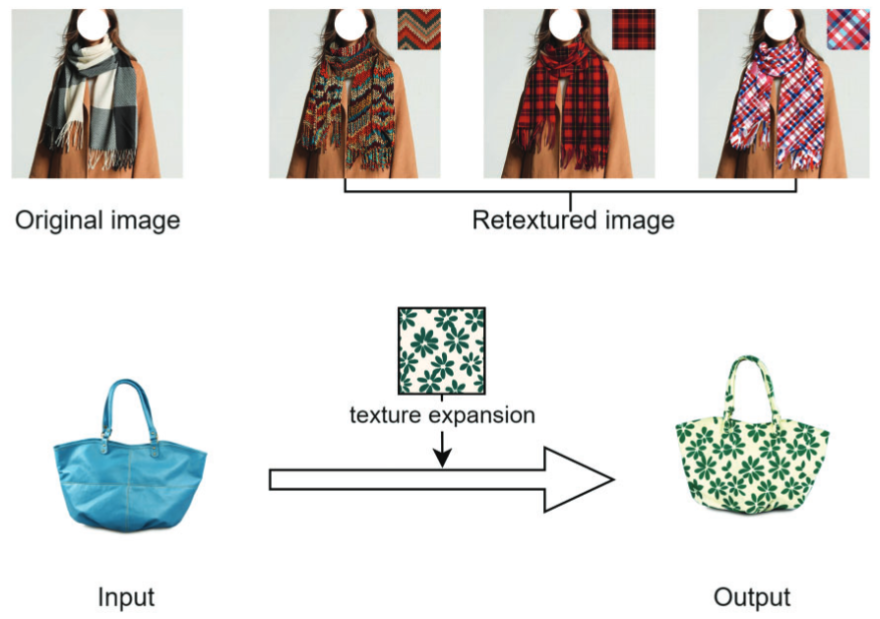
Summary: iRetexturing addresses photorealism and structural consistency in fashion item retexturing through a three-stage framework: high-resolution preprocessing, quadripartite texture synthesis, and ControlNet-guided diffusion with Canny/depth constraints.
Results: On 4,400 fashion images, the method outperforms DiffuseIT with LPIPS = 0.1385 and SSIM = 0.8323, narrowing the gap between conceptual design and production-ready assets.
Example-based Approach for Automatic Garment Pattern Generation
- Venue: Textile Research Journal, 2025
- Authors: Roujia Hong, Yarui Zhang, Qi Zhang, Diqing Qian, Yao Jin, Huaxiong Zhang, Lili He
- DOI: 10.1177/00405175251358497
- Webpage: Textile Research Journal - SAGE
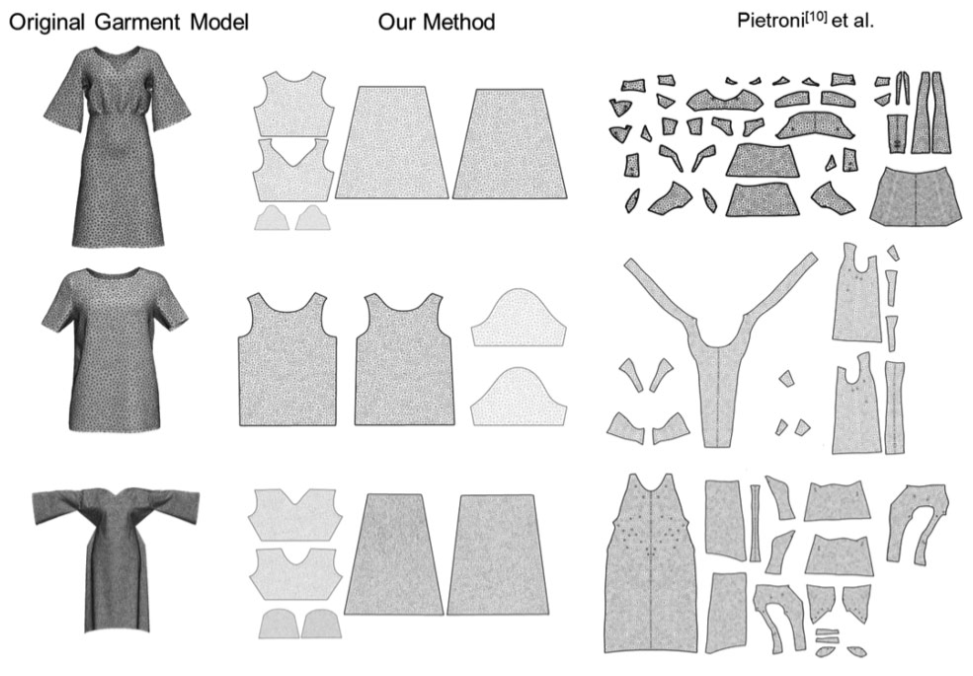
Summary: This work proposes an automated, example-based pipeline for generating 2D garment patterns from 3D meshes, combining a sparse graph transformer for panel segmentation and manufacturing constraints (symmetry + boundary smoothness) via hybrid B-spline fitting.
Results: The method achieves 99.99% segmentation accuracy on a self-constructed dataset and 100% structural similarity to target pattern templates.
Practical Projects
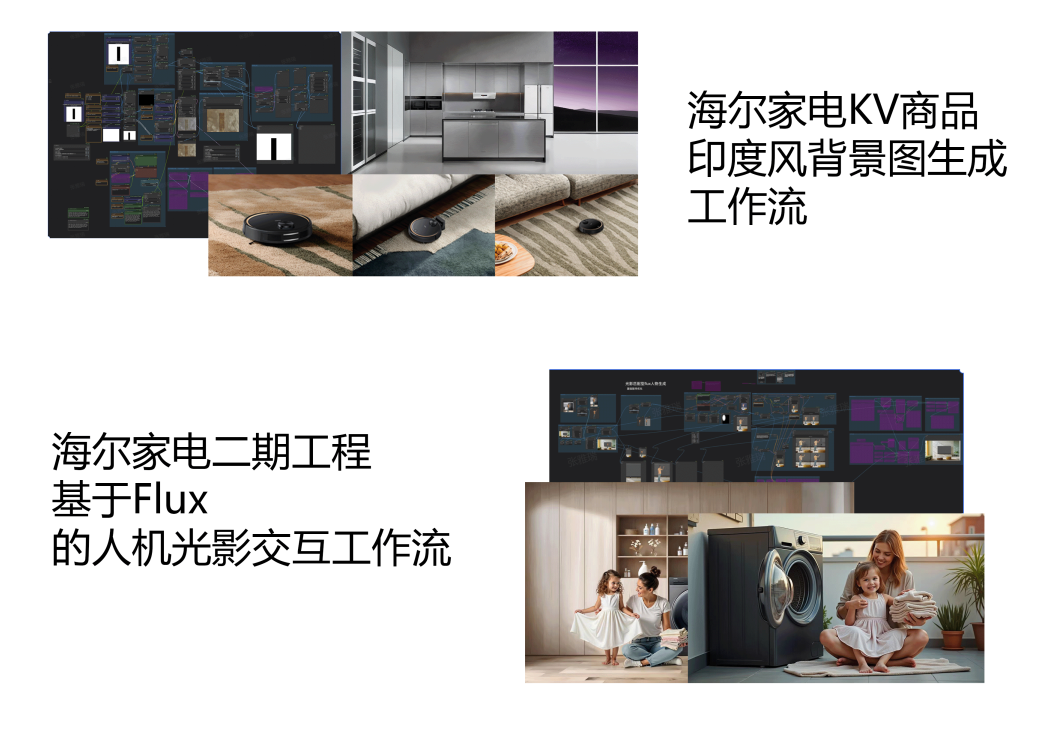
Haier Home Appliances KV Products Indian Style Background Image Generation Workflow (Internship)
- Role: AIGC workflow developer (intern)
- Context: Zhejiang University Artificial Intelligence Industrial Park Internship Program, Hangzhou ZAOWUYUN Technology Co.
- Contributions:
- Built standardized KV generation workflow for home-appliance product visuals
- Completed dataset labeling and SDXL-based background LoRA training for multiple categories
- Independently developed set-length workflow and prompt templates
- Built Flux-based human-object light/shadow interaction workflow in phase II
- Outcome: direct KV output rate up to 75%
- Tech Stack: ComfyUI, AIGC, Stable Diffusion, Flux, image algorithms
Sketch-based Garment Image Generation Algorithm Implementation (Undergraduate Mentor Project)
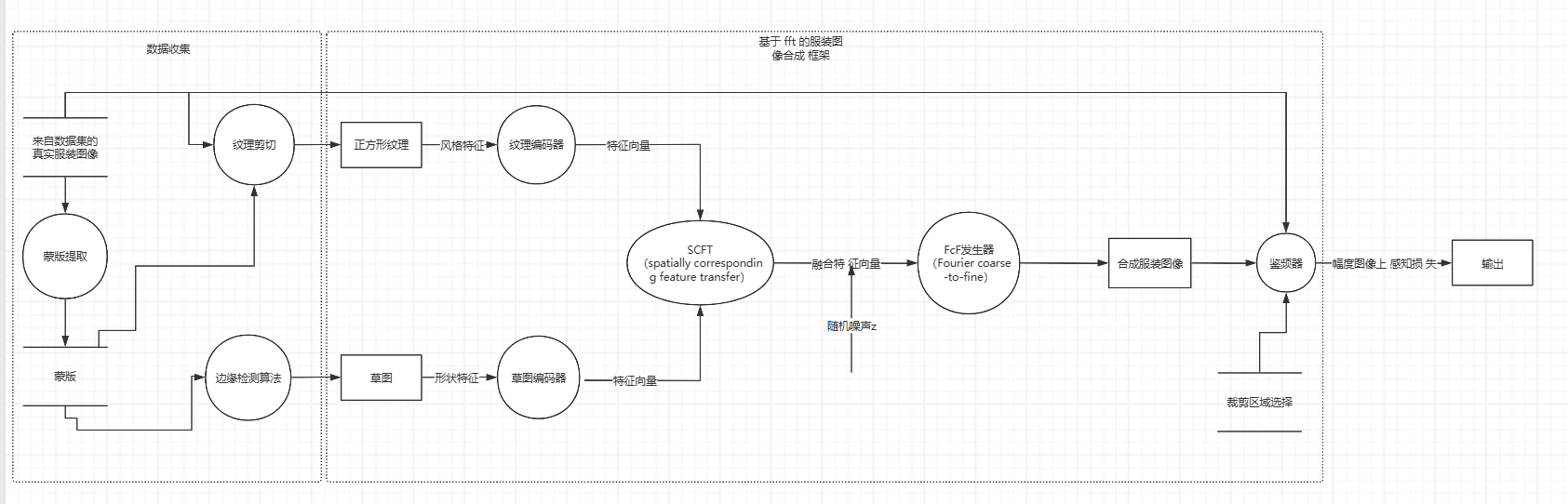
In an undergraduate mentor project, I implemented garment image generation from sketch outlines and texture patches. The project involved Linux-based experimentation and reproduction of state-of-the-art methods (including StyleGAN-family approaches) for data processing and image generation.
- Tech Stack: Python, PyTorch, Linux, deep learning, image algorithms
Multimodal Marine Document QA System based on RAG (Self-initiated Project)
- Project Overview: Built a maritime-domain RAG system using LLM + FAISS vector database, supporting cross-corpus retrieval over industry documents and academic papers, incremental indexing updates, and citation-level traceability (file name / page number).
- Key Highlight: Integrated VLM and LangGraph to optimize the multimodal RAG pipeline for marine engineering scenarios, significantly reducing long-tail hallucinations and improving evidence-grounded cross-modal tracing.
- Outcome: Project has been open-sourced: github.com/zyrzjyzxy/Sea-RAG
Automated ICL Evaluation System with Multimodal Logical Reasoning (Internship Project)
- Project Overview: Contributed to ByteDance Doubao-seed-1.8 project, focusing on a VLM-based automatic question generation and verification system.
- Key Work: Designed visual-difficulty and logical-difficulty dimensions, improved question quality through parameterized control and visual difficulty enhancement, and derived robust generation settings via stress testing.
- Final Result: Increased ICL question generation success rate from 10% to 40%, delivering high-quality datasets aligned with business requirements for the SEED technical team and effectively supporting model training and iterative performance optimization.
Fully Automated Data Annotation and Asset Repository Construction based on LLM Agent (Internship Project)
- Project Overview: Built a vision-understanding agent with GPT-4o API to achieve fully automated semantic annotation and classification for large-scale image batches.
- Key Work: Developed Selenium-based automation scripts for high-quality image crawling from platforms such as ZCOOL, built a standardized asset repository, established a multilingual label schema, and designed multi-round feedback optimization to improve annotation accuracy and consistency.
- Final Result: Significantly reduced manual annotation costs and provided high-quality data support for downstream model fine-tuning.